

How PEMF Works
Pulsed Electromagnetic Field (PEMF) technology works by delivering controlled electromagnetic pulses into the body to interact with cells, tissues, and electrical systems at a fundamental level. By influencing the body’s natural electromagnetic environment, PEMF operates through physics-based mechanisms that affect ion movement, cellular voltage, and signal communication.
Understanding the Body as an Electrical System
To understand how PEMF works, it’s essential to recognize that the human body is not just biochemical—it is also electrical. Every cell maintains an electrical charge across its membrane, often referred to as the membrane potential. This voltage difference is created by the distribution of ions such as sodium, potassium, calcium, and chloride.
Cells rely on this electrical gradient to regulate essential processes such as:
- Ion transport
- Signal transmission
- Energy production
- Cellular communication
At the tissue level, electrical activity becomes even more apparent. Nerve impulses, muscle contractions, and even brain activity all rely on precise electrical signaling. These signals are generated and regulated through changes in voltage and ion movement across cell membranes.
PEMF technology interacts directly with this electrical aspect of the body.
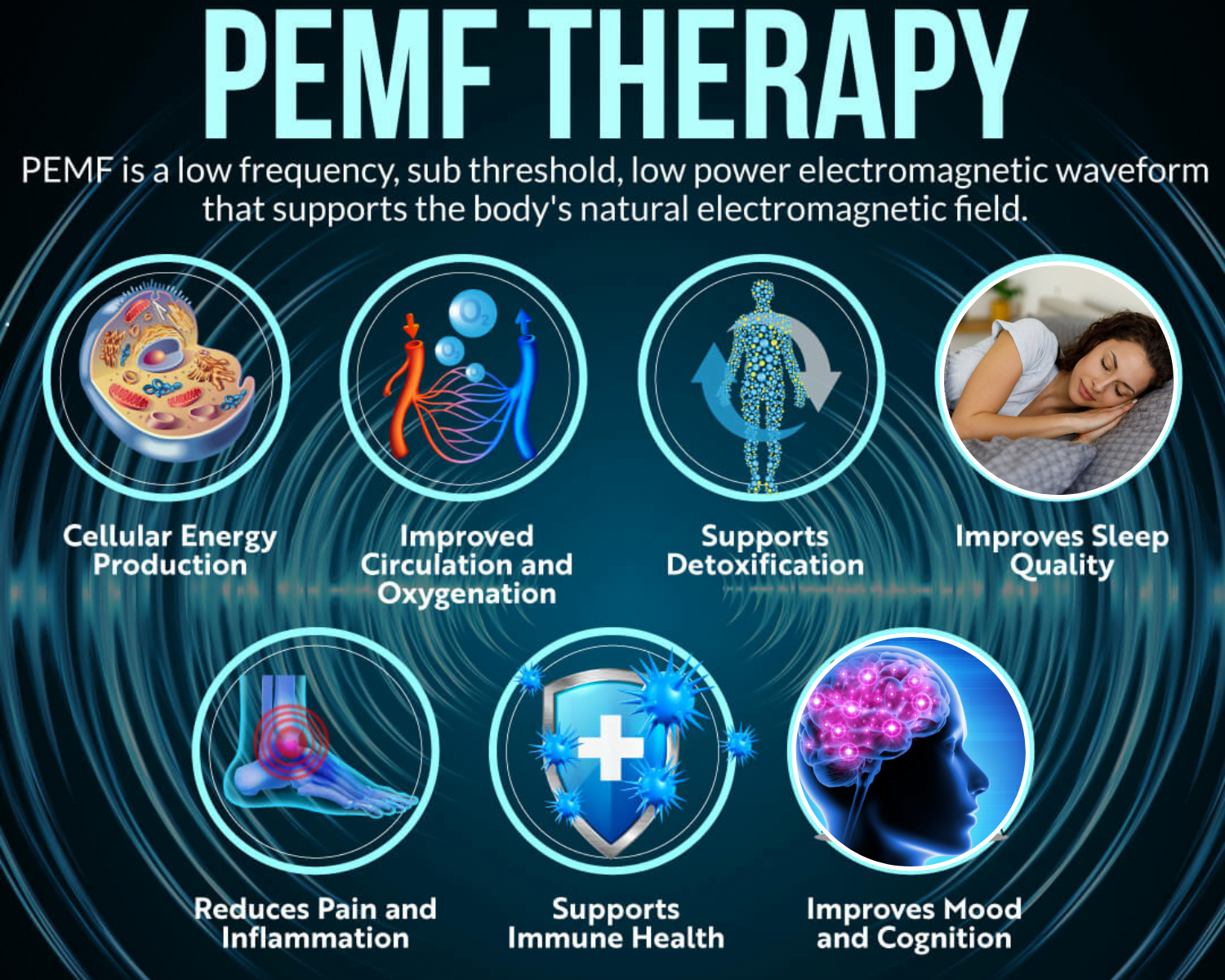
The Core Principle: Electromagnetic Induction
At the heart of PEMF technology is a principle from physics known as electromagnetic induction, first described by Michael Faraday.
When a magnetic field changes over time, it induces an electric current in nearby conductive materials. Since the human body is largely composed of water and electrolytes, it is highly conductive and responsive to electromagnetic fields.
PEMF devices generate time-varying magnetic fields. These pulsed magnetic fields penetrate the body and induce very small electrical currents within tissues.
These induced currents are not externally forced electrical signals (like those from electrodes). Instead, they are secondary responses created naturally within the body’s own conductive environment.
How Pulsed Fields Differ from Static Fields
A key aspect of PEMF is that the electromagnetic fields are pulsed, not static.
- Static magnetic fields (like a regular magnet) do not change over time
- Pulsed electromagnetic fields vary in intensity and frequency
This variation is critical because only changing magnetic fields can induce electrical currents.
Each pulse represents a rapid rise and fall in magnetic field strength. This fluctuation creates a corresponding electrical response within tissues.
The frequency, intensity, and waveform of these pulses determine how the electromagnetic energy interacts with the body.
Penetration and Field Distribution
Unlike many external technologies, PEMF fields are not limited to surface-level interaction.
Magnetic fields can pass through:
- Skin
- Fat
- Muscle
- Bone
This occurs because magnetic fields are not significantly impeded by biological tissues. As a result, PEMF can generate induced electrical activity throughout deeper structures without requiring direct contact or invasive methods.
The field strength typically decreases with distance from the source, but the penetration remains substantial compared to other modalities that rely on surface conduction.
Cellular Interaction: Voltage and Ion Movement
At the cellular level, PEMF primarily influences electrical potential and ion dynamics.
Each cell membrane acts like a capacitor, maintaining a voltage difference between the inside and outside of the cell. This voltage is essential for maintaining cellular stability and function.
When PEMF induces microcurrents in tissues, it can affect:
- The movement of ions across membranes
- The opening and closing of ion channels
- The electrical gradient of the cell membrane
These interactions are subtle but significant. Even small changes in voltage can alter how ions flow, which in turn affects how signals are transmitted and how cells respond to their environment.
Signal Modulation and Frequency Interaction
PEMF devices operate across a range of frequencies, typically from very low frequencies (ELF) to slightly higher ranges depending on the system.
Different frequencies interact with the body in distinct ways due to the concept of resonance.
Resonance occurs when a frequency matches the natural oscillation of a system. Biological systems, including cells and tissues, exhibit frequency-dependent behaviors.
When PEMF delivers pulses at specific frequencies:
- Certain tissues may respond more readily
- Electrical signaling patterns can be influenced
- Oscillatory processes may be modulated
The waveform of the signal also plays a role. PEMF systems may use:
- Square waves
- Sine waves
- Sawtooth waves
- Complex proprietary waveforms
Each waveform affects how energy is delivered over time, altering how the induced currents behave within the body.
Microcurrent Generation Inside the Body
One of the defining characteristics of PEMF is that it does not directly apply electrical current through electrodes. Instead, it induces microcurrents internally.
These microcurrents are:
- Extremely small (microamp range or lower)
- Distributed across tissues
- Generated naturally through electromagnetic induction
Because the currents are induced rather than applied, they follow the natural conductive pathways within the body. This allows for a more uniform and less localized distribution compared to direct electrical stimulation.
Interaction with Cellular Structures
PEMF does not act on a single target but interacts with multiple components of the cell.
- Cell Membrane
The cell membrane is highly sensitive to electrical changes. PEMF-induced currents can influence membrane potential and ion channel behavior.
- Cytoplasm
Within the cell, electromagnetic fields can affect charged particles and molecular interactions, particularly those involving ions and proteins.
- Mitochondria
While this article does not address outcomes, it is important to note that mitochondria are electrically active structures. They rely on voltage gradients and electron transport, making them inherently responsive to electromagnetic influences.
Field Strength and Intensity
PEMF devices vary in the strength of the magnetic fields they produce.
Field strength is typically measured in:
- Gauss (G)
- Tesla (T)
Lower-intensity PEMF systems produce weaker fields, while higher-intensity systems generate stronger pulses.
The intensity of the field affects:
- Depth of penetration
- Magnitude of induced currents
- Area of influence
However, even relatively low-intensity fields can induce measurable electrical activity due to the sensitivity of biological systems to electromagnetic changes.
Timing and Pulse Patterns
PEMF is not continuous. It operates in pulses, which introduces timing as a critical variable.
Pulse parameters include:
- Pulse duration
- Pulse repetition rate
- Duty cycle (on/off ratio)
These timing characteristics determine how energy is delivered over time.
For example:
- Short, rapid pulses create frequent changes in the magnetic field
- Longer pulses may sustain the induced effect for a greater duration
The pattern of pulsing influences how electrical responses accumulate and interact within tissues.
System-Level Effects: Networks and Communication
While PEMF interacts at the cellular level, its influence extends to larger biological systems.
Electrical signaling in the body operates through networks:
- Nervous system pathways
- Muscular activation patterns
- Intercellular communication networks
By introducing external electromagnetic pulses, PEMF interacts with these networks indirectly through induced currents.
This interaction can influence how signals propagate and how electrical activity is coordinated across tissues.
Energy Transfer Without Direct Contact
One of the most distinctive aspects of PEMF is that it transfers energy without direct electrical contact.
Traditional electrical stimulation requires electrodes placed on the skin to deliver current. PEMF, on the other hand, uses magnetic fields to induce currents internally.
This allows for:
- Non-contact energy delivery
- Uniform distribution across a broader area
- Reduced dependence on skin conductivity
The absence of direct current application is a defining feature of how PEMF operates.
Relationship to Natural Electromagnetic Environments
The body is constantly exposed to natural electromagnetic fields, including:
- The Earth’s magnetic field
- Environmental electromagnetic signals
PEMF systems introduce controlled, structured electromagnetic pulses that differ from these natural background fields in:
- Intensity
- Frequency
- Pattern
This controlled input allows for precise interaction with the body’s electrical systems.
Device Design and Coil Systems
PEMF devices use coils to generate magnetic fields. When electrical current passes through a coil, it creates a magnetic field perpendicular to the direction of the current.
Different coil designs affect:
- Field shape
- Field distribution
- Depth of penetration
Common configurations include:
- Flat coils for surface coverage
- Cylindrical coils for localized focus
- Full-body mats for broader exposure
The geometry of the coil determines how the magnetic field spreads and how it interacts with the body.
Wave Propagation Through Tissue
Magnetic fields propagate through space and tissue without requiring a conductive path. This allows PEMF signals to move through the body without significant attenuation at interfaces between different tissue types.
Unlike electrical currents applied through electrodes, which follow the path of least resistance, induced currents from PEMF are generated wherever the magnetic field changes.
This results in a more distributed interaction across tissues.
Scaling from Micro to Macro Effects
PEMF operates across multiple levels simultaneously:
- Microscopic level: ion movement and membrane potential
- Cellular level: electrical gradients and signaling
- Tissue level: coordinated electrical activity
- System level: network interactions
The same underlying principle—electromagnetic induction—applies across all these levels, but the observable effects differ depending on the scale.
Summary: The Mechanism of PEMF
PEMF works through a combination of physical and biological principles:
- Generation of pulsed magnetic fields
- Penetration of these fields into the body
- Induction of microcurrents within tissues
- Interaction with cellular electrical systems
- Modulation of ion movement and voltage gradients
- Influence on signal transmission and communication networks
This process is entirely based on electromagnetic physics and the body’s inherent electrical properties.